I was on sabbatical for the 2024-2025 academic school year, which means I did not experience the first big wave of students using generative AI at the university. I remember seeing all posts, laments, distress, and fears (as well as having multiple conversations) regarding the rapid “take down” of reading, writing, learning, education as we know it. So, when my sabbatical was coming to a close and the new year was on the horizon, I knew I had to figure out what my responses would be, what my policies would entail, and what practices, philosophies, and conditions needed changing, updating, even abandoning. (ChatGPT 5 would launch in August 2025 just as the autumn term started.) Long before this crisis (and moral panic), I was already grappling with the inclusion of other digital technologies in my pedagogy–so much so I wrote a “Teaching (with) Technology” philosophy. While the statement needs to be updated, much of it still holds true and is directly relevant to generative AI:
- “I believe that teaching with technology and teaching technology must begin with developing critical approaches, different kinds of “literacy,” and integrations and implementations that do not simply drop technology into a course for technology’s sake.”
- “Again, it is important that the technology I do use is framed well, integrated into the curriculum, and responsive to the class’s needs. It is also important to consider access, students’ proficiency, and whether or not a particular technology replaces or augments some other mechanism or material.”
- “Finally, in line with developing new “literacies,” I think that we must think about technology and the cultures around technology as objects of analysis and study. In other words, technology is more than just a neutral tool or apparatus. Rather, technology involves and reveals all sorts of norms, values, practices, and assumptions that can be unpacked to help us think about our relationship to technology.”
I still very much believe these statements, and I think they are even more salient given the intensification of digital technologies today–be they social media, algorithmic surveillance, and of course, generative AI. In the beginning of all of the kerfuffle, I was largely ambivalent, agnostic about generative AI. Given my own work in video game studies, digital humanities, media studies, speculative literature, and popular culture, I am not shy when it comes to new tech or technocultural possibilities. However, I am also slow to adopt certain tech because integration requires time, consideration, and care, and I am very aware of the problems of any new technology given the lessons embedded in most science fiction. Therefore, I went into the fall with very different attitudes and ideas about what to do and how to address the digital elephant in the room.
This blog post is just the beginnings of what I am trying to suss and sort through regarding generative AI, teaching, pedagogy, mentoring, and perhaps the whole university/academic project overall. But that’s more than I can tackle right this moment (and probably would require a whole other lifetime to do). However, I have some initial musics, provocations, and plans.
A Generative AI Hippocratic Oath
First, before the technolibertarians and technoutopians come at me, I think AI technologies–including generative AI–are important, vital, and useful, particularly in modeling, simulations, and testing huge amounts of data. (Big grain of salt, big grain of salt, big grain of salt.) In the hands of those well-trained with deep specialist knowledge, the technology is a key tool in research, development, and exploration. However, not all AI technologies are created equal, and certainly not all AI users are the same. I am deeply suspicious of technology companies and institutions, particularly in their past, present, and future motivations for pushing generative AI on the masses. All of the buzzwords around generative AI–creativity, accessibility, communication, and so on–are untruths (at worst) and romanticizations (at best) that still require time, effort, consideration, testing, and reengineering before they should be adopted whole cloth. Given Silicon Valley’s decades long model of releasing products to the be beta tested by the masses (rather than paying actual programmers or quality assurance testers), generative AI is a giant experiment that we are all playing with, paying for (in ways innocent and deeply not).
I am always reminded of my graduate work and my dissertation (which I have not cracked open since I defended way back in 2012), which in many ways informed my teaching (with) technology philosophy and resonates with the current cybercultural landscape today. The dissertation and much of my early video game studies and digital humanities work riffs on what Thomas Foster calls the “key antimony” or “unbridgeable gap” of posthuman technologies–in my case repurposed to mean digital media, cyberspace, and cyberpunk imaginaries–which articulates the double-bind that the very technologies used for liberation and transformation can be used for domination and destruction. See fire, gunpowder, fossil fuels, computers, social media, and now, generative AI. There are so many stories about generative AI being and wonder, and there are so many more stories about the technology failing badly (or the technology’s overlords behaving badly).
Therefore, pedagogically, I think it is really important to say “generative AI” or “gen AI” when we mean the suite of large language models on the market now. It is important to distinguish between what AI is and is not, what AI means and doesn’t mean. Moreover, I really think we shouldn’t describe generative AI technologies as a tool (or nothing more than a tool). I think it shorthands entirely too much. Making it just a tool is an imperfect and minimizing metaphor. I think these technologies can be leveraged as a tool much in the same way as scalpel or a shovel or an automobile or a gun can be, but there has not yet been enough social, cultural, legislative, and political understanding (much less training) to ensure confidence and compassion in said “tool.”
I maintain a skeptical perspective and one modeled on my previous experience with LGBTQ+ community organizing and STI health training–I am not here to evangelize “abstinence” but rather “informed choice” and “informed consent.” I think it really important that everyone negotiate and navigate what their relationship to a technology is or is not. I strongly believe that this technology problem cannot be solved by more technology (again, that’s the Silicon Valley way) but by social engineering, by community standards, by establishing certain values, best practices, and constraints. I want to work all of this into a paper, but finding the time is the problem. So, let this blog post do some flag planting. In essence, my generative AI philosophy is about limits, boundaries, and harm reduction–kind of like a generative AI Hippocratic Oath. My generative AI philosophy is that students should develop critical awareness, thinking, and skills in the technology (not instrumentalize it as just a tool) in very narrow, slow, and deeply supported ways. But, more importantly, they should be talking about generative AI all of the time to develop their own philosophy around the technology.
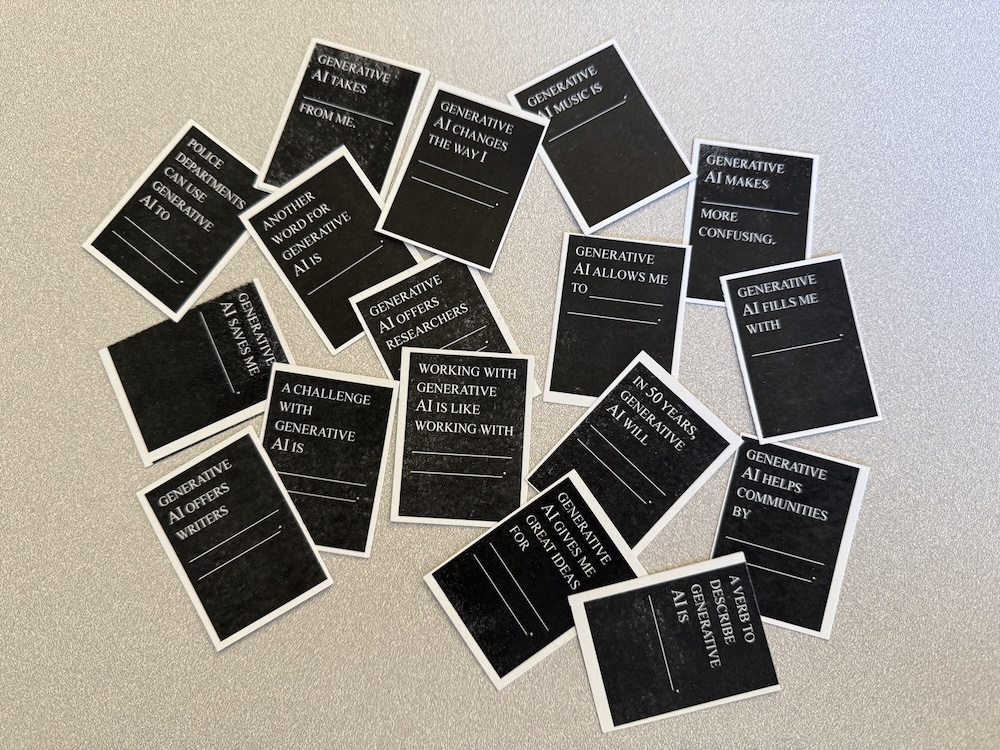
Humanities Against AI (HAAI)
To that end, I have decided to spend the better part of the first week of classes to talk about generative AI. I am still working on a few exercise, activities, and documents to help frame the conversation and to explore how generative AI (might) fit into the class, into our lives, and into the world at large. I wanted to draw on my recent experiments with freeform LARPs, which are often rules light, short and focused, socially-minded live-action role-playing games, to develop a LARP to enact my generative AI (teaching) philosophies and to encourage students to develop their own. Thus, I give you the working draft of Humanities Against AI (HAAI)–which uses a broader umbrella of “AI” drawing on literature, movies, and teaching:
Inspired by Cards Against Humanity, the first half of HAII asks you to respond to black prompt cards by filling out white cards with your answers. I hope you noticed that the prompt cards were not all negative but a mix of possibilities. Using those answer cards, groups played a few rounds of traditional CAH, drawing Black cards and offering up White answers that were the most interesting, silly, or outrageous responses.
The second half of HAII asked the groups to play a freeform larp (a rules light, often socially-minded live-action role-playing game) where one (or two) people took on the role of a generative AI — giving themselves a name of course — and the remaining players were the Users. Users could prompt the AI with a black card, and the AI would return an answer using one of the White cards. Players were encourage to improvise the back and forth between Users and AI using the prompt/answer as the starting point of the conversation.
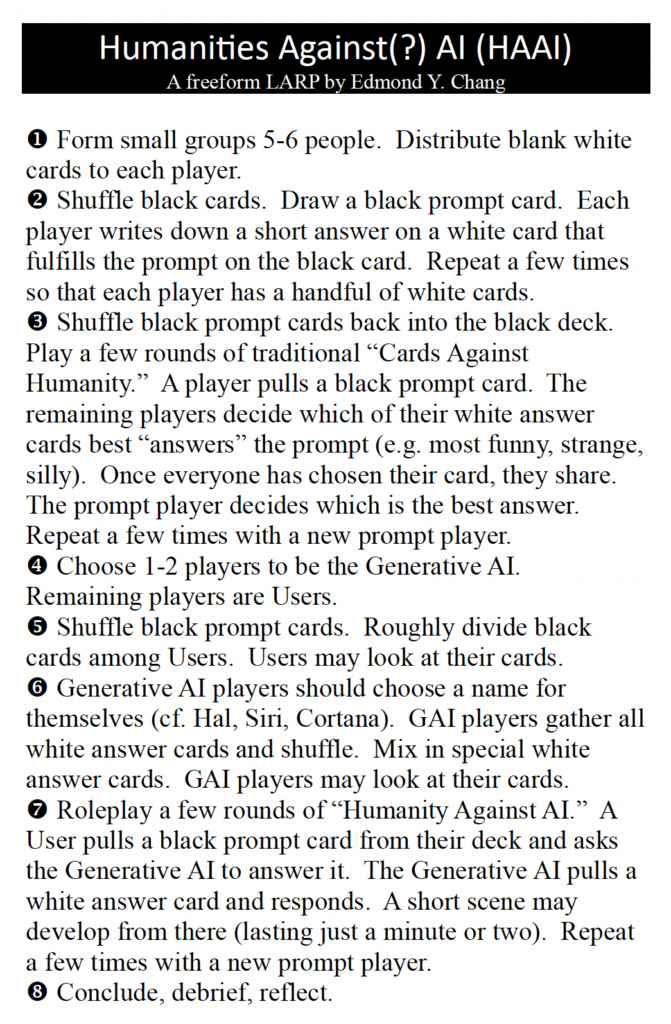
Over a couple of class sessions, we play through the different steps of HAAI. I know right now it is too complicated with too many moving parts. I want to streamline the experience a bit more and get to the LARP part sooner. But, the brainstormed responses from the students are very telling, and the humorous interaction between black card prompts and white card responses (the key mechanic in Cards Against Humanity) often lays bare the tensions, anxieties, and concerns students have with the technology.
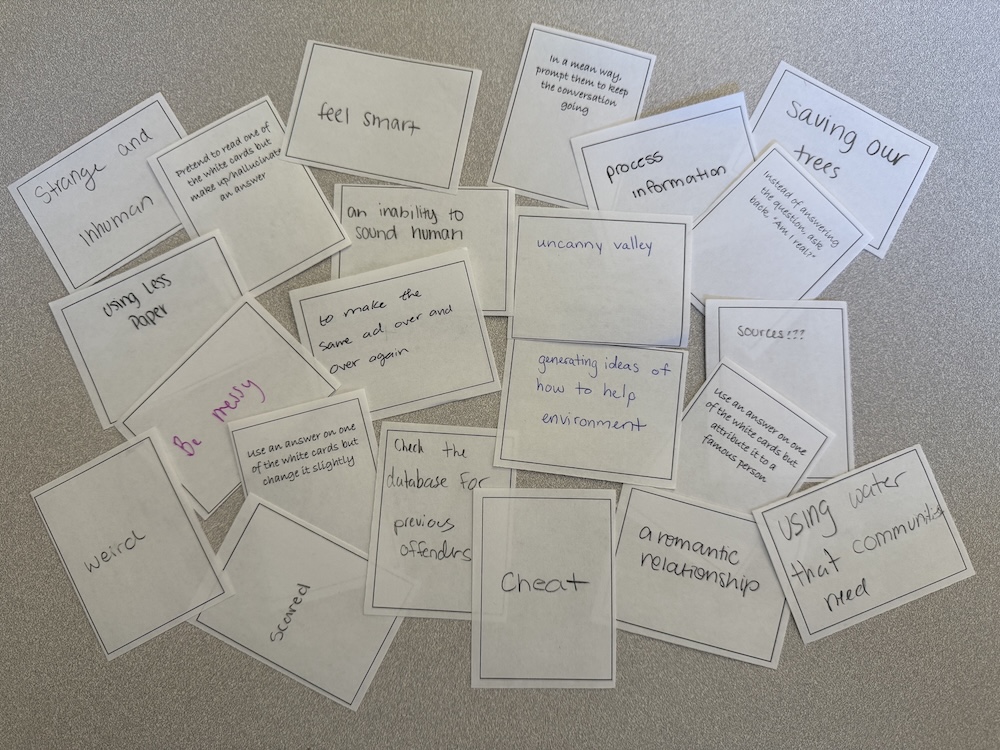
I have only run HAAI a couple of times, but I want to continue the practice. Students also have time to reflect on the game in class and on Canvas. There is a world where I might develop a study to measure the efficacy or outcomes of the LARP and discussions (but I hate futzing with IRB). Anecdotally, I think the open discussion and the game (even though it might come across as silly or strange in an English literature classroom) are useful. They lay the foundations for curiosity, interaction, communication, and hopefully, trust. I mean there are so many articles and studies about the success of sexual education and frank, age-appropriate discussions of sexual health, both physically and emotionally. So, why not try to follow in those pedagogical and philosophical footsteps?
For now, my classrooms are AI-free zones. After the LARP, after playing with these ideas, and after our first week discussions and reflections, I spell out my individual philosophy and classroom policy regarding generative AI technologies. I strongly encourage them to actively, metacognitively develop a philosophy of their own. Many of the reflection prompts for HAAI ask things like: What do you really care about in your life? How do those things fit into your life? How are those things affected by technology, by generative AI? How do these technologies fit into yourself? Students these days are deeply social justice minded, particularly regarding identity, bodily autonomy, and self-expression, and those beliefs and values should dovetail with whether or not they “partner” with generative AI. In other words, what they do in their other courses or in their own personal lives is up to them. But we agree that in this one space, in this one forums, we are going to focus on human-centered and humanities-centered reading, writing, researching, critical thinking, making, and doing.
For now, to bring this rambling post to a close, this is my syllabus statement and course policy on generative AI:
Generative AI-Free Zone
This course will be a generative AI free zone. Students are encouraged to explore and understand their relationship to and limits for technology and to develop a philosophy of technology use that reflects their social, cultural, ethical, environmental, and creative values. This course asks you to make informed, ethical, and consensual choices about generative AI. All formal and informal assignments submitted for this course should represent your own thinking and effort and should be prepared entirely by you. There may be times when the use of AI-generated text or images would be appropriate in this course, particularly regarding reasonable accommodations and accessibility, but you should obtain advance permission from the instructor for any use of generative AI technologies. Without clearance, the use of generative AI at any stage of your work in this course (as indicated by manual and/or cross-digital detection) will be zeroed and constitutes academic dishonesty, a violation of course policy and of the Ohio University Student Code of Conduct (see below).