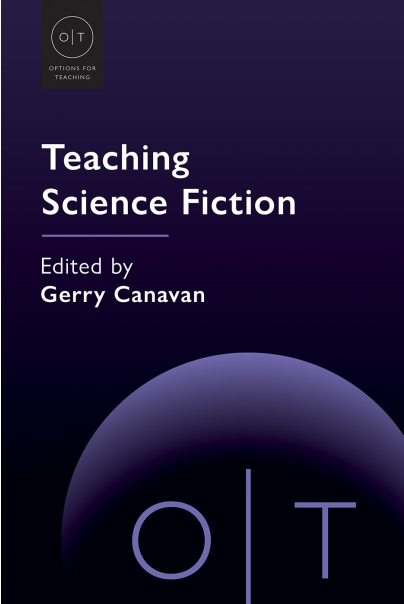
Teaching Science Fiction, a new book from MLA Books, is finally slated to come out in Spring 2027 (now available for preorder). The collection is edited by famed Gerry Canavan:
In its often dystopian and apocalyptic visions of a world yet to come, science fiction wrestles with important issues of our time and can help prepare us for a future that seems very much in flux. Addressing texts from the late nineteenth century to the present, Teaching Science Fiction will help instructors introduce science fiction’s power to draw readers into alternate worlds in order to mirror the possibilities—both positive and negative—present in our own.
The essays in this volume use various theoretical lenses—including utopian theory, feminist rhetorical studies, game studies, and environmental humanities—to foreground the sociopolitical aspect of science fiction and its relation to social justice. Essays shine a light on feminist and postcolonial utopias, ecofiction, ethnofuturism, and Indigenous futurism, some of the many manifestations of science fiction that seek to interrogate conceptualizations of race, gender, ethnicity, language, and species.
My essay “Tomorrow Is Here: Asianfuturism and Other Ethnic Futurisms” is included in the volume. The collection was originally called Teaching Science Fiction in the Literature Classroom and outlined the uncommon inclusion of genre fiction like SF in more traditional, “canonical” lit courses. I guess the shortening of the title signals that the distinction is moot. My essay is a close reading of Toshio Mori’s Yokohama, California and Sequoia Yagamatsu’s How High We Go in the Dark. The abstract reads:
Betsy Huang argues in Contesting Genres in Contemporary Asian American Literature, “[I]t can be said that Asian Americans entered the science fiction imaginary prior to the recognition of science fiction as an identifiable genre in the early decades of the twentieth century” (95) yet they have rarely authored science fiction in spite of having always been in it.” This paper draws on my experience of including Asian American science or speculative fiction in more “traditional” 20C/21C American or Asian American survey courses and argues that the absence of Asian American SF must be addressed in curricula. In particular, how might we imagine a course on Asian American SF as a way to engage canon, genre, and popular culture as it intersects with race, gender, sexuality, nation, and technology? How might we define “Asianfuturism?” Given that SF, in the words of Huang, “affords Asian American writers a unique way to engage in subversive political and ideological critique not by contravening genre conventions, but by using them to rewrite the rules of the genre,” this essay hopes to articulate the importance of including Asian American SF in our literature classrooms.
I look forward to seeing the book in print! Many thanks to Gerry Canavan for being such a generous editor. Hopefully, my essay and the collection will find a place in people’s syllabi and on people’s shelves.