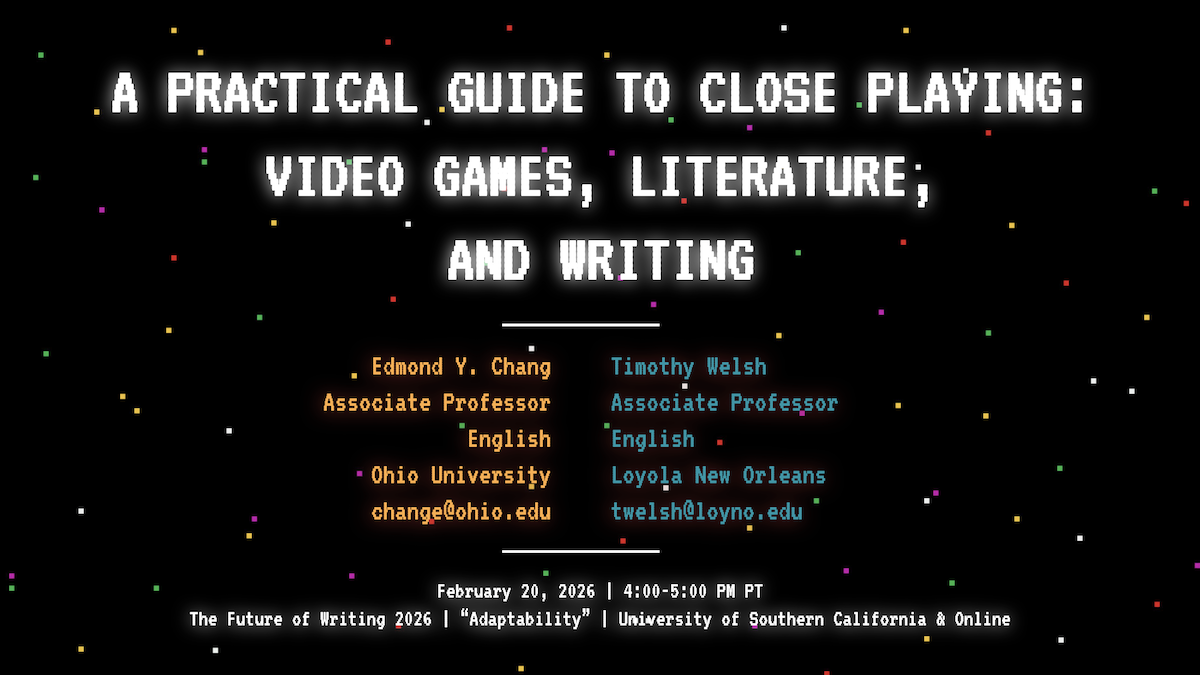
In 2023, I attended the first Future of Writing symposium on “Interactivity.” This year’s conference is themed “Adaptability.” I will be presenting with my co-author Timothy Welsh a workshop drawing on our book Video Games, Literature, and Close Playing as a response to generative AI in the classroom, the need for algorithmic literacy, and writing about/for games. We present on the virtual day on Friday, February 20, 2026, 4-5 PM PT, online. Here is the description of the event:
The Writing Program at the University of Southern California, the Institute on Ethics & Trust in Computing, and the Viterbi Engineering in Society program invite you to The Future of Writing 26: A Symposium for Teachers, a two-day event in which we look down the road to what is coming next. Free and open to all.
Join lively interactive sessions, lightning talks, and panel discussions on topics from first-year college writing to journalism, from professional to creative writing. Explore the ever-changing norms of digital pedagogy and envision how our choices will shape the classroom praxis of the decade ahead.
This year’s theme: Adaptability
Sponsored by the University of Southern California Dornsife Writing Program, Viterbi Engineering in Society Program, USC Libraries’ Ahmanson Lab, Levan Institute, and the Humanities and Critical Code Studies Lab & The Electronic Literature Organization
Background
The first wave of generative AI has hit. At the same time, colleges and universities are going into “resilience” mode as we face the loss of federal funding, restrictions on academic freedom, and declines in undergraduate applications. Precarity. Uncertainty. Instability.
Okay, deep breath.
In response to the adversity of the current moment, writing instructors are, as always, on the front lines of higher education, encountering students who are now facing a new set of options. With engaged student-centered pedagogy, with lessons and creativity and critical thinking, with flipped courses that take students out of the classroom, we have never been a community of stagnation. Our chief strength: adaptability.
Whether we are adjusting to ever changing students or responding to an ever-involving information landscape, we have adapted our pedagogy to meet the moment. We explore empathy and affect, accessibility and linguistic variety, ethics and sustainability, and, yes, ways to serve include, invite, and welcome a varied student body into a level learning environment. To teach writing is always to tinker, to try new approaches, and, at times, to return to tried and true techniques.
Let’s gather to share, to discuss, and to question how we can adapt our classes to meet the future of writing.
Registration is available here: https://www.eventbrite.com/e/future-of-writing-2026-online-and-in-person-tickets-1982385299796.