|
ENG 2540
Dr. Edmond Y. Chang Download the course policies and syllabus (PDF).
"A person who won’t read has no advantage over one who can’t read."
"You think your pain and your heartbreak are unprecedented in the history of the world, but then you
read. It was books that taught me that the things that tormented me most were the very things that
connected me with all the people who were alive, or who had ever been alive."
|
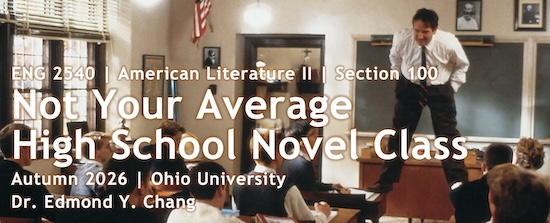
MAYA ANGELOU once said, "When I look back, I am so impressed again with the life-giving power of literature. If I were a young person today, trying to gain a sense of myself in the world, I would do that again by reading, just as I did when I was young." It is this sense that literature is important, that literature can reveal something about ourselves and the world, and that reading is a practice and lifeway maintained and sustained over time that is central to this class. In other words, literature is more than just words on a page, literacy is not a destination or a merit badge, and reading is as much about rereading as writing is as much about revising. This class will take up reading and rereading as critical practice by pointedly revisiting literature commonly taught in high school curricula in the US, literature needing rescue and revivification from this-is-so-boring mindsets, from the constraints of teaching-for-the-tests, and from the too easy themes and summaries of notes by Cliff and Spark. This is not your usual high school novel class. Texts may include in Mark Twain, F. Scott Fitzgerald, Nella Larsen, J.D. Salinger, John Okada, Toni Morrison, Qui Nguyen, Robin Wall Kimmerer, and Percival Everett. A REQUIREMENT for this class is a well-developed curiosity about the world, about the culture we live in, and about the cultural productions we imagine, produce, and consume. In other words, this class is about reading, critiquing, and analyzing our culture through different literatures and texts. We will engage different practices enjoying and analyzing literature and other media, as well as develop literary, feminist, queer, and intersectional strategies, habits, and perspectives of reading, thinking, and writing. Foremost, we will read and write and research with pleasure and for pleasure. We will also close read for analysis. And lastly, we will read and deploy literature as theory, as dramatizing the concerns, wonders, struggles, and politics of lived life and experience. SPECIFICALLY, our course goals and learning objectives include:
• Students will be able to demonstrate an understanding of key authors and literary movements of
American literature, 1865 to the present. IN OTHER WORDS, we will use literature, other mediums, and popular culture as vernacular theory to think, talk, write about and to interrogate the world around us. We will spend the quarter asking and addressing difficult, challenging, and sometimes discomforting ideas, questions, and topics, focusing on different identities, bodies, histories, desires, experiences, and even struggles and violences. Whether on the page, screen, on campus, or in the community, we will explore and engage multiple perspectives, levels of familiarity with the material, and heady and heartfelt responses. In other words, our class will be a safe, respectful, but not necessarily comfortable space. However, you do not have to believe in the ideas, theories, and analyses of the course, but you do have to demonstrate that you understand and can apply them. While pushing boundaries and comfort zones are essential to critical thinking, making connections, and intellectual and personal freedom, see me with concerns and queries, for reasonable accommodations, and for further resources on campus.
|
"Do work that matters. Vale la pena."
"All modern American literature comes from one book by Mark Twain called Huckleberry Finn."
Required Course Texts & Materials
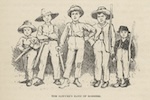
• Mark Twain, Adventures of Huckleberry Finn.
|
|
Course Requirements
Presentation & Roundtable Download the course policies and syllabus (PDF).
|
Requirements & GradingYour grade should not be the sole exigence or motivation for this class. It is the hope of the course that you walk away from our class with something more. Find some pleasure and some edification and some knowledge from this class (or any class really) and success is usually not far behind. With that in mind, your grade will be a reflection of engagement, effort, close reading, critical thinking, writing, and participation. Critical Question Presentation and Roundtable (20%) You will be a required to sign up in small groups for an oral presentation and roundtable during the course of the semester. For your presentation, you will read the texts assigned for a particular week, summarize and articulate two or three main points from the week's scholarly or critical text (as assigned), generate a critical question connecting the theory to the text, and contribute to in-class and online discussion for the week. Curations should have a group presentation plan, a substantive framing post, may include media, and each group member must contribute to the discussion and post. In-Class Quizzes (20%) There will be ten or more in-class five-minute quizzes at various times during the semester. These quizzes serve as a review of the week's main ideas, terms, texts, and readings. These quizzes might include identifications, fill-in-the-blanks, definitions, and short answers. Creative Responses (10%) Over the course of the semester, you will write a short-short story or poem, create a drawing, and generate a critical review as an alternative way to explore and demonstrate the ideas and goals of the course. These creative responses will be evaluated on completion and your critical, thoughtful engagement with the prompts. Critical Reflections (30%) Over the course of the semester, you will have four opportunities to complete short, analytical reflections that ask you to respond to the literature, the theoretical texts, and to assess your own work and performance in class. These reflections will be due (tentatively) at the end of Week 4, Week 8, Week 12, and Week 15. You must complete two of the three opportunities, one of which must be in the first half of the term. Critical reflections will be cumulative and based on the class readings, literature, other media, and course discussions. Participation and Preparedness (20%) Preparedness and participation form a large component of your final grade. It is essential that you prepare, attend, and participate in class. Missing class may seriously compromise your ability to do well in this class. Moreover, negative participation will hurt your participation grade. Participation is determined by 1) your respectful presence in class and interactions with me and others, 2) your willingness to discuss, comment, and ask questions, 3) your preparation for class, which includes having the required materials and doing all of the assigned reading or work for class, 4) your engagement and collaboration in group work, presentations, office hours, and course events, and 5) your completion of all required threads, other weekly posts, and overall care and use of the class Canvas--bookmark the address, check and respond regularly, and think of the blog as an extension of class: https://ohio.instructure.com/courses/81397/
|
"Books are a uniquely portable magic."
"When I look back, I am so impressed again with the life-giving power of literature. If I were a young
person today, trying to gain a sense of myself in the world, I would do that again by reading, just as
I did when I was young."
|
|
|
AttendanceAttendance is required. If you are absent, you miss the explanation of an assignment, the discussion of a reading, the chance to participate, and overall, the class as a community of learning. Also, you are expected to be in class on time. In the first minutes of class I may make important announcements, establish the agenda for the day, begin immediately with an important lesson, or field questions. If you come in after we start class, even by only a few minutes, you are late and will be mark as such. Chronic or conspicuous attendance problems will negatively affect your overall participation grade for the class.
Moreover, absences for more than a third of the course / 14 class sessions may result in a failing
grade regardless of reason. University-sanctioned and reasonable accommodations will be taken into
account. All absences are your responsibility. If you know you are going to miss class, please let
me know (via email) as soon as possible and make any necessary arrangements. When you do miss class,
always find another student to get class notes or see me during office hours to discuss or make up
missed work in a timely manner. You are always responsible for all material covered during your absence.
|
|
|
MLA Paper Formatting 1) 1" margins top, bottom, left, and right on each page. 2) Single-spaced block header on the first page only with your name, date, course, my name:
Student Name 3) Appropriate title. 4) Papers are double-spaced with paper page numbers in the upper right hand corner; no extra space between paragraphs. 5) Standard Times Roman Font, 12 point only. 6) Correct MLA citation and bibliographic format. A paper turned in without a bibliography automatically fails and will be returned with no comments. 7) No generative AI.
|
Assignment FormatAll papers must be typed or produced on a word processor. All documents should be saved in Microsoft Word format (or if necessary Rich Text Format). All papers must follow the manuscript format outlined by the assignment. Unless instructed otherwise, all papers must use MLA citation and documentation conventions. All papers must be neatly printed (in black), single-sided, stapled in the top, left-hand corner if necessary, and not be three-hole punched. Papers that do not follow these format guidelines will not be accepted. They will be returned unread to you. Papers will be regarded as late until they are resubmitted in the proper format. Always make a backup copy of every paper you turn in, lest you be one of the unhappy people whose paper is eaten by the computer. You may even want to take the precaution of e-mailing your paper to yourself as an attachment during the drafting process and certainly before you exit the document and leave the computer. Or you may want to invest in cloud-based file storage like OneDrive (which all OU students have already have access) or DropBox.
Evaluation RubricOver the course of the semester, your assignments will receive feedback and comments that will identify what you are doing well and what still needs improvement. Your grades assess your fulfillment of the assignment, the quality of work, detail, analysis, and argumentation, overall effort, and finally, style, polish, and risk taking. Consider the following evaluation rubric as signposts or a kind of legend to your progress and evaluation:
• Outstanding (A/A+): Offers a very highly proficient, even memorable demonstration
of the trait(s) associated with the course or assignment goal(s), including some
appropriate risk-taking and/or creativity. No generative AI. |
Late Assignments All assignments must be done completely and turned in on time. Late assignments will be penalized a letter grade for every day that they are late. So, if your essay is late by one day and you received a B- for your work, then your final grade would be a C-. Moreover, I will not comment on late work. However, you still need to complete late work or you will receive a zero. If you miss the due date of a paper, you must notify me and make arrangements to get the paper to me as soon as possible. Unless previously arranged, I DO NOT accept assignments via email. Remember that a paper has not been officially handed in until it is in my hands. Never turning anything in late is always the best policy. |
|
Contact Dr. Chang
Office: Download the course policies and syllabus.
|
Finding HelpMy office and office hours are listed above. I am available during that time or by appointment (which can be held virtually). I encourage you to come see me early in the quarter even if it is just to talk about the class, about the assignments, or about school in general. I may ask you to meet with me when I think a conference would be useful. My office is located on the third floor of Ellis Hall (east of Alden Library), Room 331.
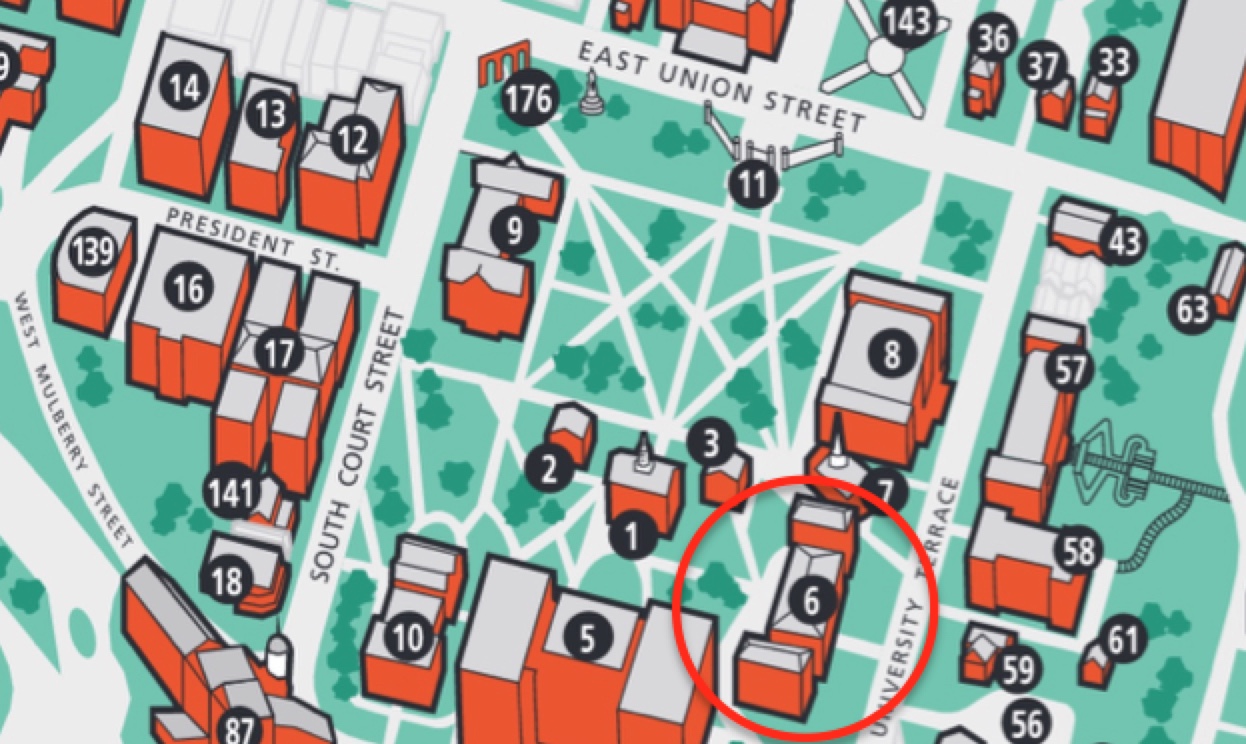
Email is the best way to contact me. I will do my best to answer your emails and Bb posts, usually within twenty-four hours. If there is an emergency, please contact the main English office in 201 Ellis Hall. You can also find additional writing and academic help at the Writing Commons on campus, a good resource for this class and other classes. The Writing Commons is located in the Academic Advancement Center (AAC) on the second floor of Alden Library and offers a variety of services including help with reading, writing, brainstorming ideas, organization, citation, and research. See https://www.ohio.edu/student-success/academic-achievement-center to make an appointment and for more information. Further resources, both on- and off-campus can be found on the Links page of the course website: http://www.edmondchang.com/courses/2540/links.html.
Generative AI-Free
This course will be a generative AI free zone. Students are encouraged to explore and understand
their relationship to and limits for technology and to develop a philosophy of technology use that
reflects their social, cultural, ethical, environmental, and creative values. All assignments
submitted for this course should represent your own thinking and effort and should be prepared
entirely by you. There may be times when the use of AI-generated text or images would be appropriate
in this course, particularly regarding reasonable accommodations and accessibility, but you should
obtain advance permission from the instructor for any use of generative AI technologies. Without
clearance, the use of generative AI at any stage of your work in this course constitutes academic
dishonesty and is a violation of course policy and of the Ohio University Student Code of Conduct (see below).
|
Learning (With) Technology Unless you have an official accommodation, the use of technology in our classroom is a privilege, not a right. Mobile devices like phones, media players, and cameras should be off and put away. Computers and tablets should be used for note-taking, in-class work, and readings only. Print is generally preferred for course texts and readings, but full-size e-versions are acceptable provided the student is able to readily highlight, annotate, and index. Finally, be conscientious and respectful in the use of the course website and social media and post no material from class to the internet or non-class sites without explicit permission from the instructor and the class. Keep in mind these three rules:
1) Use the Right Tool for the situation and the task--keep it simple and elegant,
Inappropriate use and abuse of technology in class will result in the taking away of technology privileges for the offending student and/or class as a whole. |
|
|
AccommodationsAny student who feels they may need an accommodation based on the impact of a disability should see me or contact me in the first week of class to discuss their specific needs and provide written documentation from Student Accessibility Services. If you are not yet registered as a student with a disability, please contact Accessibility Services at 740-593-2620 or visit the Accessibility Services office in Alden Library 230. The OU Accessibility Services website is: https://www.ohio.edu/accessibility.
Academic DishonestyAll students are required to uphold the highest academic standards. Plagiarism, or academic dishonesty, is presenting someone else's ideas or writing as your own. In your writing for this class, you are encouraged to refer to other people's thoughts and writing--as long as you cite them. Many students do not have a clear understanding of what constitutes plagiarism, so feel free to ask questions at any time. For our class, plagiarism includes:
• a student failing to cite sources of ideas If you have any doubt about how to cite or acknowledge another's writing, please talk to me. Any plagiarism or academic dishonesty will result in failure of an assignment or of this course, and the Office of Community Standards and Student Responsibility may impose additional sanctions. It is always better to be safe than sorry. Please review the Ohio University Student Code of Conduct, which includes full definitions, procedures, and appeals processes: https://www.ohio.edu/student-affairs/community-standards/student-code-of-conduct.
Harassment, Discrimination, and Sexual Misconduct
Ohio University and our course are committed to a safe, supportive, and inclusive learning
environment. All OHIO faculty and staff share in the responsibility to create a safe learning
environment for students and for the campus as a whole. With the exception of the confidential
resources listed below, all OHIO employees are required to report any instances of sexual
harassment or other sexual misconduct to the Title IX Coordinator in the Office of Civil Rights
Compliance (CRC), even if they learn of it through classroom assignments, discussions, or the
like. Reports are made to the Title IX Coordinator in the Office of Civil Rights Compliance and
can be made electronically at
https://www.ohio.edu/civil-rights by selecting the "report sexual misconduct" tab, by phone at 740.593.9140, by fax at 740.593.9168, or by email at
civilrights@ohio.edu or
civilrights@ohio.edu. If you are not yet ready to have
something that happened to you or someone else reported to CRC, you can speak confidentially
with the Survivor Advocacy Program (740-597-SAFE or
https://www.ohio.edu/survivor,
Counseling and Psychological Services (740.593.1616 or
https://www.ohio.edu/student-affairs/counseling) or Campus Care (740.592.7100).
|
"If you don't tell your story, somebody else will."
"You must write, and read, as if your life depended on it."
"I just write all the time. In my whole life I've never had what I've heard people talk about writer's
block. I've never had that. Life is like a song to me. I just hear everything in music, so I have never
once thought, ‘Well, I'm never gonna be able to write again.’ I've got thousands of songs."
|
|
|
© 2026-27 Edmond Chang. All original material. All rights reserved. Contact the webmaster of this site. These pages are best viewed with Mozilla Firefox or Google Chrome. Open your browser to the largest viewable area. These pages are hosted by ED(MOND)CHANG(ED)AGOGY, the academic, professional, and creative website of Edmond Y. Chang. |
|